

The graph and its evidence
Every answer Knossos gives comes from one stored graph of your project, and every fact in it points back at a file and a line. This page explains what a scan puts in that graph, how to read the evidence, confidence and origin that come with each fact, what a static scan cannot prove, and what it never does to your project. Which question each tool answers is on the pages that follow, starting with structure analysis.
What a scan produces
A scan walks the project, hands the source files to a worker per language, and writes what the workers found into SQLite, in the data directory and never in your project. You get these kinds of fact:
| Fact | What it is |
|---|---|
| Component | A node: a module, class, interface, trait, enum, function, method, property, package, route or similar. Each has a stable ID and a kind. |
| Edge | A relationship between two components: calls, imports, extends, implements, constructs, injects, references, contains and more. |
| File | A source file the scan read, with its path, language, size, line count and content hash. |
| Boundary | A named group of components, either declared by you or inferred from the project's manifests and namespaces. |
| Role | A classification of one component, such as quality.test_module or application.service, with the rule that assigned it. |
| Diagnostic | A warning or error about the scan itself: a file too large, a symlink skipped, a syntax error. |
| Snapshot | One complete scan. The newest is the active graph. Earlier ones are archived for history. |
A shell script (.sh or .bash, or a file with no extension whose shebang names sh, bash, dash or zsh, such as bin/run starting with #!/bin/sh) is a file component as soon as the scan finds it, and the literal paths it runs, such as ./tools/check, php bin/tool "$@", source lib/env.sh, . lib/env.sh or xargs php bin/lint, become launches edges from the script. A path with a variable, a glob or ~ in it names nothing, and neither does a line inside a heredoc (<<EOF to EOF), which is text handed to a command.
A project file no worker reads, such as a CI tool, is a component of kind file once something names it: a launches edge from code that starts it, or a note on its path. Its name is the path from the project root, and it carries no file row because its contents are never read. A path that is excluded, ignored by a .gitignore, outside the root or not a regular file names nothing. The scan works these out again every time, so the component goes when the file or the note does, and a note added or removed is picked up by the next scan even when nothing else changed.
Run knossos architecture-summary on a scanned project to see the kinds and counts for your own graph. A scan of a mixed PHP and TypeScript codebase produces mostly methods, classes and functions, joined mostly by calls, contains and constructs edges.
Components and edges
A component is identified by its language, kind and canonical name, so the same symbol keeps the same ID across rescans. An edge is an occurrence, not a summary: its ID includes the place in the source where the relationship was written. Two calls from one method to the same target, on different lines, are two edges. That is why list_usages can list call sites one by one.
contains edges record structure only: a class holds its methods. The queries that ask what depends on what use a fixed set of dependency kinds instead: routes_to, calls, dispatches, handles, listens_to, constructs, injects, binds, observes, depends_on, imports, uses_middleware, references, extends, implements, returns, exports, re_exports, uses_trait, calls_endpoint, resolves_to and launches. Pass edge_kinds to narrow them. contains is rejected there. How resolves_to joins a request to its route is on from request to handler.
When code refers to something outside the scanned tree, such as a framework class or a package that is not installed, the edge still needs a target. The scan creates a stand-in component whose kind starts with external_, marks it possible and unresolved, and keeps the edge. Rankings leave these out unless you ask for them with include_external.
Boundaries and roles
A boundary groups components so you can ask questions about modules rather than single symbols. You declare boundaries in knossos.json or with --boundary on knossos scan. Without them, Knossos infers boundaries from what the project already says about itself: one per manifest of a Cargo, Composer, Node or Python project (composer:<name>), one per top-level PHP namespace (namespace:App), one per top-level directory of TypeScript code (module:src) and one per top-level directory of Python code (python-package:<directory>). A TypeScript project's own config path names its boundary. Every boundary carries a source of explicit or inferred, so an inferred grouping is never mistaken for a decision someone made. A component can sit in more than one boundary. list_boundaries shows them, and declared rules are written against them.
The pane labels each component with one boundary: a declared one before an inferred one, so an inferred boundary labels only the components no declared one holds. The Overview tile (28 +6 inferred) and the Boundaries tab (28 declared · 6 inferred) therefore count two figures: the boundaries you declare, and the inferred ones that still label something. list_boundaries lists every boundary, including inferred ones that label nothing, so its count can be higher.
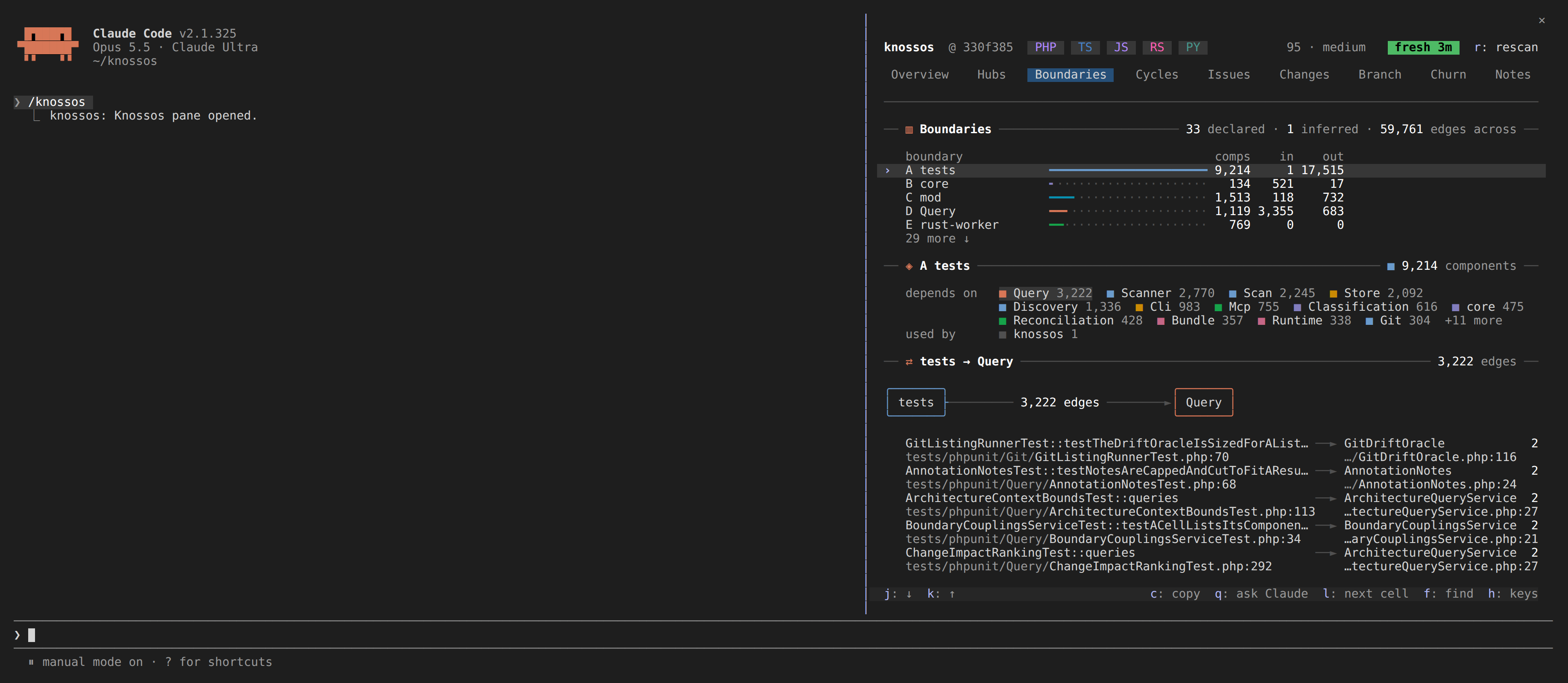
Roles come from classification rules that run after the workers: file-name and path conventions, framework conventions, manifest entry points and test modules. A role tells later queries how to treat a component. A test module stays out of the hub ranking, and a controller is not reported as dead code just because nothing calls it.
Evidence
Evidence is the file and line range that justifies a fact. Every component and every edge carries one, and the scanner protocol rejects a fact without it.
{
    "kind": "implements",
    "origin": "ast",
    "confidence": "certain",
    "evidence": {
        "path": "src/Scanner/Worker/ProcessScannerClient.php",
        "start_line": 10,
        "end_line": 10
    }
}
The path is relative to the project root and the lines are one-based. An answer is therefore checkable: open the file at that line and the relationship is there, or it is not. The same shape appears in via on impact results, on each hop of a flow, on each row of list_usages, and in the evidence array of the response envelope. Over MCP the default compact verbosity keeps the first three evidence records and collapses via to the edge kind. Ask for verbosity: "full" to get everything, which is what --json on the CLI prints.
Confidence and origin
Confidence says how sure the scanner was. Origin says where the fact came from.
| Confidence | Meaning |
|---|---|
certain | The scanner resolved it directly: a declaration, an import it could follow, a call on a typed receiver. |
probable | The scanner inferred it, for example a call on a variable whose type came from an assignment. |
possible | The scanner could not resolve it. Stand-ins for external code are always possible. |
| Origin | Where the fact came from |
|---|---|
ast | Parsed straight from source. Most of any graph. |
framework_convention | A recognised framework pattern, such as a route table or a decorator. |
derived | Worked out by Knossos from other facts: external stand-ins and most role assignments. |
The scanner protocol also accepts composer and config for custom scanners. Every query that takes min_confidence filters weaker facts out and never upgrades them. A path is only as strong as its weakest edge, which is why impact and flow results report path_confidence.
What static analysis cannot prove
A scan reads source text. It does not run anything, so anything decided while the program runs is outside what it can see:
- reflection, dynamic dispatch and calls through a name held in a variable;
- wiring that lives in configuration, a container or a registry array;
- code generated or loaded at runtime, and dynamic imports;
- decorators, macros and monkey-patching whose effect depends on execution;
- anything in a dependency that is not part of the scan.
Each language page lists what its worker does and does not resolve. See TypeScript, PHP and Laravel, Python and Rust.
Knossos labels the limits instead of hiding them:
- Confidence. An edge the scanner had to guess is
probableorpossible, and you can filter on it. - Warnings. Every result carries
warningsthat qualify it. Impact says it is a conservative blast radius, a flow says it is a plausible static path, and dead-code results say they are candidates only. - Absence proves nothing. A flow query with no path returns an empty list. An unreferenced component is a candidate, and a component the scan could not type is demoted to
possible. See dead-code candidates. - Bounds. Every walk has limits on depth, nodes, edges and time. Hitting one sets
truncatedand names the reason inbounds, so a partial answer never passes for a complete one. - Diagnostics. A file the scan skipped or could not parse becomes a diagnostic with a code, so a gap in the graph has an explanation.
- Type-only imports. An import that exists only for the compiler is dropped when looking for cycles, so a loop closed only by such imports is not reported. Impact, flow, hub and policy checks still count it.
Treat the graph as strong evidence about what the code says and silent about what the runtime does.
What the scan never does
The scan treats your project as untrusted input:
- It does not install dependencies. If
node_modulesorvendoris missing, references into them becomeexternal_stand-ins instead of an error. - It does not import or run your code, and does not boot a framework or start a bundler. The workers parse: the TypeScript worker uses the compiler's analysis, the PHP worker a parser, the Python worker the standard-library
astmodule and the Rust worker a syntax parser. - It does not follow symlinks. A link is skipped with a diagnostic, whether it points inside the project or out of it.
- It does not read what you told it to ignore. Version-control and dependency directories (
.git,node_modules,vendor, virtual environments, build output) are skipped by default,.gitignoreis honoured, andignoresinknossos.jsonadds to both. By default a file over 2,000,000 bytes is skipped with a warning, and a project over 100,000 files fails the scan instead of scanning part of it. - It does not hand your environment to the workers. Each worker is a separate process with a neutral working directory, a short allow-list of environment variables, a request timeout and, for the PHP and TypeScript workers, a memory limit.
- It does not replace a good graph with a bad one. A scan that fails or is cancelled leaves the previous snapshot active, and
list_projectsshows the state aslatest_scan_failedorlatest_scan_cancelled.
Configuration and text files such as manifests, HTML files and READMEs are read as text to find the paths they name, never executed. Git is only run read-only, for the commit a scan matches and for the change signals in change review.
Where to go next
- Structure analysis walks the graph: impact, flow, cycles, hotspots and placement.
- Finding components is the read surface.
- Declared rules and budgets turns boundaries into checks.
- Scan history compares one snapshot with another.